How to Measure Pin Diameter, Ear Width and Frame Width Before Buying an Excavator Attachment
Practical guide to choosing buckets, couplers, grapples, breakers and other attachments based on the actual coupler measurements, not just the machine’s tonnage.
Choosing an excavator attachment should not be based only on “tonnage”. In practice, real compatibility depends on several coupler measurements: pin diameter, ear width, pin-to-pin spacing and, depending on the type of head or coupler, also the frame width or coupling area. It is no coincidence that manufacturers and technical catalogues use measurements such as attachment ear width and pin-to-pin spacing, and that MTKS already provides advice based on tonnage, pins and ear width in its attachment product sheets and categories.
Buying without measuring properly can lead to two very common problems: the attachment does not physically fit the machine or the quick coupler, or it fits but does not work correctly because the coupler geometry does not match. In addition, different coupler systems — fixed, wedge-style, pin-grabber or hydraulic coupler — can completely change compatibility, even if the excavator belongs to the same tonnage range.
Do you need machinery, attachments or spare parts?
Discover our full catalogue and receive professional advice.
Why accurate measurement is so important
Tonnage remains useful, but it should be understood as a first filter, not a guarantee of compatibility. In fact, the MTKS website itself emphasizes verifying the correct part number by tonnage, pin size, and lug spacing, and for specific products, exact measurements such as width, pin size, and lug-to-lug spacing are published. This confirms a key point: two machines of similar tonnage can use attachments with different coupling sizes.
The type of attachment must also be considered. A simple bucket can be accommodated with basic geometric measurements, but a hammer, a brush cutter, a grapple, or a compactor also require checking the auxiliary hydraulics, the direction of the lines, and the flow and pressure ranges. John Deere, for example, publishes attachment catalogs with specific hydraulic flow and operating pressure ranges, and its compact excavators are described as being compatible with single- or dual-line attachments.
What each measurement means
- Pin diameter
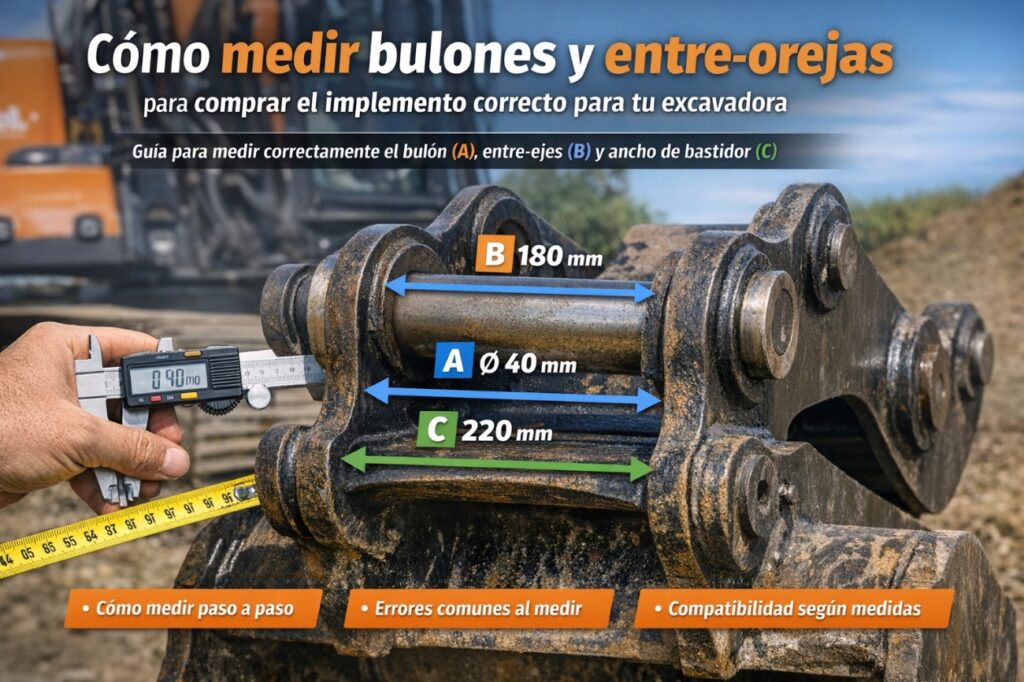
The pin is the shaft that connects the attachment to the arm or to the quick coupler. The key measurement here is its actual diameter. In many product sheets, this measurement appears directly as “30 mm pin”, “50 mm pin”, etc.
- Ear width
The ear width is the internal distance between the two ears or side plates of the attachment head, in other words, the space where the corresponding part of the coupler fits. In international technical documentation, it is often referred to as attachment ear width or head/ear width.
- Pin-to-pin spacing
Although it is not mentioned in your title, this measurement is essential and should not be left out. In many workshops and catalogues, it may appear as centre-to-centre distance, eye-to-eye distance or pin-to-pin spacing. It is one of the most decisive measurements to ensure that the attachment follows the correct movement when the arm opens and closes.
- Frame width or coupling area
When we talk about frame width, we are usually referring to the overall width of the head or structural coupling area. This is a useful measurement for detecting possible interference with the coupler, adapters or special geometries. It is not always published under the same name, but it is usually reflected in the general dimensions of the coupler assembly in manufacturers’ technical documentation.
How to measure step by step
Step 1: identify what you are going to measure
Before taking any measurement, decide whether you are going to take references from:
the current attachment you already use,
the quick coupler,
or the machine arm if the attachment is mounted directly with pins.
This is important because compatibility can change depending on whether you use a fixed coupler, a manual coupler or a hydraulic coupler. Manufacturers such as Bobcat or Deere offer different coupler systems, and that changes the mounting geometry.
Step 2: measure the pin diameter
Use a caliper to measure the outer diameter of the pin. If the pin is installed and accessible, measure it directly. If not, measure the inner diameter of the housing, but only as a secondary reference, because wear can affect the reading.
The practical recommendation is to take the measurement in millimetres and, if in doubt, take several readings at different points of the pin. In real MTKS product sheets, you can see how this measurement clearly changes between references: for example, a TB016 quick coupler lists a 30 mm pin, while an MTKS 70 for 6–9 tonne machines lists a 50 mm pin.
Step 3: measure the ear width
Here you need to measure the clear internal space between the two side plates of the attachment. Measure it in a straight line and avoid measuring the outside width, as this is a very common mistake.
In practice, this measurement often appears in catalogues as coupler width or head width. That is why, when a product sheet says “Width 125 mm” or “Width 235 mm”, that figure is usually a direct reference for geometric compatibility.
Step 4: measure the pin-to-pin spacing
This is one of the most commonly forgotten measurements and one of the most important for avoiding problems. It is not enough for the ears to “fit” and for the pin diameter to match: the distance between the centres of the pins must also match.
In technical documentation, this is known as pin-to-pin spacing, and in many Spanish commercial product sheets it is expressed as eye-to-eye distance. MTKS, for example, publishes values such as 130 mm or 300 mm for this distance in its products.
How to measure it well
Measure from the centre of the first housing to the centre of the second one.
If it is easier for you:
measure the outer edge of the first hole,
measure the outer edge of the second hole,
and correct the measurement according to the pin diameter.
The important thing is that the final figure represents centre-to-centre distance, not edge-to-edge distance.
Step 5: measure the frame or head width
This measurement is used to verify that the attachment not only “fits”, but also works without interference with the coupler, the arm or the head reinforcements. It is especially useful when dealing with reinforced attachments, quick couplers, adapters or non-standard heads.
In coupler documentation, you may find not only the ear width, but also the general dimensions of the whole assembly, precisely because the complete coupler matters, not just the pin hole.
Step 6: confirm the type of coupler
This point is decisive. It is not the same to use:
a pin-on or fixed attachment,
a wedge-style system,
a pin-grabber,
or a hydraulic quick coupler.
Deere describes fixed and wedge-style coupler options for compact machines, and Bobcat works with hydraulic quick-change and pin-grabber systems across different ranges. Two attachments with similar measurements may not be interchangeable if the coupler system does not match.
Step 7: if the attachment is hydraulic, check flow and pressure
For a mechanical bucket, this does not apply in the same way, but for a breaker, mulcher, compactor, grapple or auger, measuring the coupler is not enough. You also need to confirm:
hydraulic flow,
working pressure,
whether the machine works with one-way or two-way attachments,
and whether the return line or auxiliary line is compatible.
John Deere publishes attachments with minimum and maximum flow and pressure ranges, and its compact excavators specify auxiliary lines and return selectors for one-way or two-way hydraulic accessories.
Step 8: use tonnage as a final check, not as the only criterion
The tonnage range is still important because it affects working capacity, attachment weight and the machine’s overall balance. Cat, for example, publishes the operating weight of its mini excavators and links to specific attachment compatibility guides. But the practical lesson is clear: tonnage guides; measurements confirm.
Most common errors when measuring
The first mistake is buying based only on tonnage. It is useful to know whether you are working with a 1.5 t, 5–7 t or 8–10 t machine, but that does not replace the coupler measurements. MTKS product sheets themselves combine compatibility by tonnage with specific measurements such as pin diameter, width and eye-to-eye distance.
The second mistake is confusing the outer width with the internal ear width. The third is forgetting the centre-to-centre distance. The fourth is not specifying the type of coupler. And the fifth, very common with hydraulic attachments, is not checking flow and pressure before requesting a quote.
A practical example to make it clear
Suppose someone is looking for a coupler for a small machine and finds a model compatible with a Takeuchi TB016. At MTKS, it appears with a width of 125 mm, a 30 mm pin and an eye-to-eye distance of 130 mm. If that same customer then looks at an MTKS 70 quick coupler for 6–9 tonne machines, they will see completely different measurements: 235 mm width, 50 mm pin and 300 mm eye-to-eye distance. Both are “excavator couplers”, but geometrically they have nothing to do with each other.
That is why, when choosing a bucket, coupler, grab, grapple or powertilt, the correct procedure is not just to ask “will it fit a 5-tonne machine?”, but to provide the exact coupler measurements.
What information should you send to get it right the first time?
When you want to order an attachment, ideally you should send:
exact machine brand and model,
serial number, if possible,
front and side photos of the current coupler,
pin diameter,
ear width,
centre-to-centre distance,
frame or head width,
type of coupler,
and, if the attachment is hydraulic, available flow and pressure.
The serial number can be especially useful because some manufacturers use it to validate specific compatibilities; Bobcat, for example, recommends checking parts and compatibility with the serial number in its parts catalogue.
Our recommendation
If you really want to choose the right attachment, follow this rule:
Do not buy based on “similarity”. Buy based on measurements.
The correct process is:
identify the type of coupler,
measure the pin diameter,
measure the ear width,
measure centre to centre,
check the frame/head width,
confirm the tonnage,
and, if applicable, check the auxiliary hydraulics.
At MTKS, this is exactly how we work: we do not guide you only by the machine category, but by the real compatibility of the coupler. If you send us the excavator model, some photos and the pin diameter, ear width, centre-to-centre distance and frame width measurements, we will help you find the correct reference and avoid incorrect purchases.
How to Measure Pin Diameter, Ear Width and Frame Width Before Buying an Excavator Attachment
Choosing an excavator attachment should not be based only on tonnage. To ensure real compatibility, it is necessary to correctly measure the pin diameter, ear width, pin-to-pin spacing and the frame or coupler head width.
Why choosing by tonnage alone is not enough
The excavator’s tonnage is a useful first filter, but it does not guarantee that the attachment will fit correctly. Two machines within the same tonnage range may have different coupler measurements, so it is essential to check the real dimensions before buying buckets, couplers, grapples, breakers or any other accessory.
Which measurements should be taken on the coupler
The most important measurements are the pin diameter, the internal ear width, the centre-to-centre distance between pins and the overall frame width or coupling area. These references make it possible to confirm whether the attachment physically fits and whether it will work with the correct geometry.
How to measure the pin diameter of an excavator
The pin is the shaft that connects the attachment to the arm or to the quick coupler. Its outer diameter should be measured with a caliper, preferably in millimetres, taking several readings if there is wear.
How to measure the ear width
The ear width is the clear internal distance between the two side plates of the attachment head. It is important to measure the inner gap and not the outer width, as this is one of the most common mistakes when checking coupler compatibility.
Pin-to-pin spacing
Pin-to-pin spacing, also known as eye-to-eye distance or centre-to-centre distance, is a key measurement to ensure that the attachment follows the correct opening and closing movement. Matching the pin diameter and ear width is not enough.
Frame or coupler head width
The frame or coupler head width helps check that there are no interferences with the arm, the quick coupler or the attachment head reinforcements. This measurement is especially important for reinforced attachments, adapters, powertilt systems or non-standard heads.
Check the type of coupler
Compatibility also depends on the coupler system being used. A pin-on attachment, fixed coupler, wedge-style coupler, pin-grabber or hydraulic quick coupler may require different measurements and geometry, even if the excavator has a similar tonnage.
Hydraulic attachments: flow and pressure
For hydraulic attachments such as breakers, mulchers, grapples, compactors or augers, coupler measurements are not enough. You also need to check hydraulic flow, working pressure, auxiliary line direction and whether the machine works with one-way or two-way hydraulic circuits.
Information to send before buying
To choose the correct attachment, it is advisable to send the excavator brand and model, serial number if available, photos of the coupler, pin diameter, ear width, centre-to-centre distance, frame width, coupler type and hydraulic data if the attachment requires it.
MTKS helps you find the right attachment
At MTKS, we work with real compatibility measurements to avoid incorrect purchases. If you send the excavator model, photos and coupler measurements, our team can help you find the right reference for your machine.